
TL;DR:
- The paradox: most store team incentives still pay on lagging outcomes such as sales, margin, shrink and fresh waste. Stores are held accountable for these numbers, but many of the causes sit outside the store: forecasting, ranging, supplier quality, promotions.
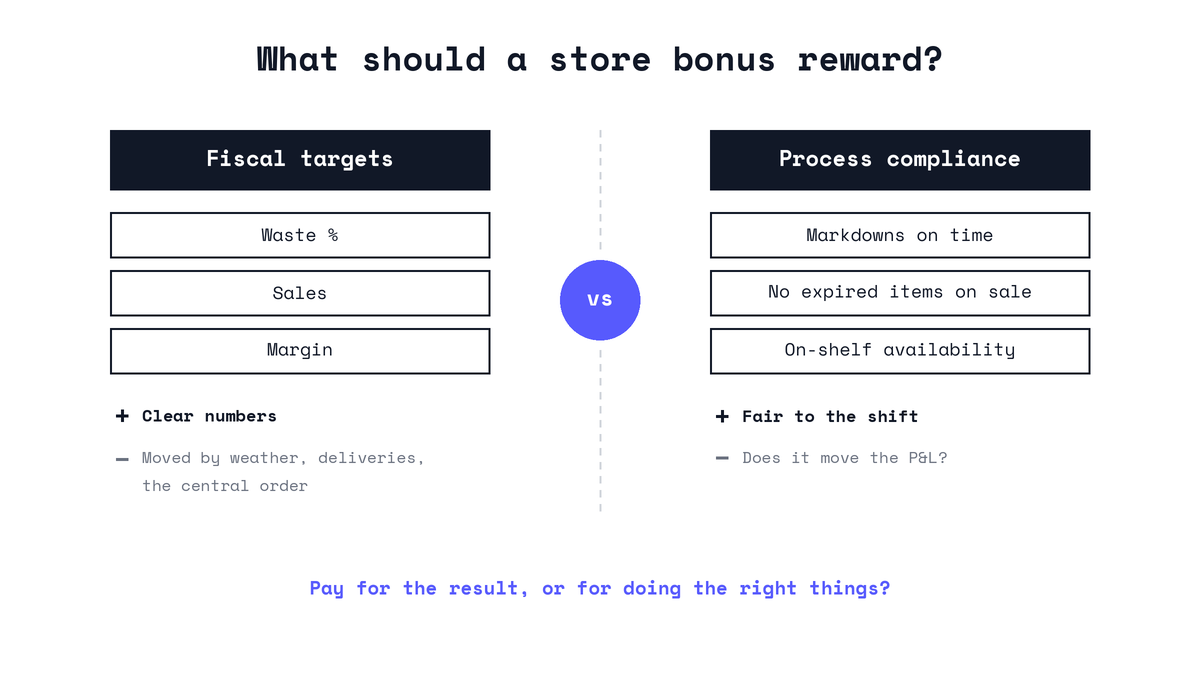
- What’s changing in 2026: retailers surveyed by ECR are moving from fiscal waste targets to process compliance, meaning whether the right tasks were done in the right time window.
- A fair model has two layers: the business keeps watching waste and margin, while the people on shift are judged, and paid, on what they control: the right pack, at the right time, at the right depth, done on time.
Store team incentives are meant to reward good work. In fresh retail, they often reward a good week instead. If waste is down, was it a good shift, or just a quiet Tuesday? If waste is up, was it the team, the central order, a late delivery or a rainy weekend? Most bonus schemes can’t tell the difference, and the people on shift know it.
How does a store manager bonus work today?
Mostly on lagging outcomes, with SOPs instead of decision tools.
In most grocery chains, the store manager bonus, and the store manager KPIs behind it, rest on results that show up after the fact: sales, gross margin, labour cost as a share of sales, shrink and fresh waste. Department managers are often measured the same way. These are the numbers the business runs on, so it makes sense that they are watched closely.
Frontline staff usually get standard operating procedures: check dates at set times, apply markdown stickers according to a rule sheet, pull expired packs, record waste. What they rarely get is a decision tool that tells them which pack needs attention now, how deep a discount should be, or what it will do to the full-price pack next to it.
So the scheme pays on the outcome, while the job is a long list of small decisions made with little support. When the outcome is good, everyone did well. When it’s bad, someone did badly. Nobody can say exactly what.
The paradox: accountable in the store, caused elsewhere
Stores carry the accountability for problems they often don’t create.
In June 2026, ECR Retail Loss published a survey of 29 retailers operating more than 64,000 stores across 12 countries. Nearly half of them place accountability for food waste in store operations.
Yet stores don’t control forecasting, ranging, supplier quality or promotions. As ECR puts it, stores “often inherit problems created elsewhere.” A forecast that overshoots, a promotion that leaves extra stock, a delivery that arrives a day late with short dates: all of it lands in the store’s waste number.
That is the core of the paradox. The store is the place where waste becomes visible, so it’s the place that gets measured. But a store team bonus tied to that number pays, or withholds pay, partly for decisions made at head office or by a supplier.
Why does one lagging KPI distort behaviour?
Because people optimise the number, not the outcome behind it.
ECR’s research warns that a single lagging KPI changes behaviour in ways nobody intended:
- Measure waste value, and people under-record waste.
- Measure donations, and stores over-order.
- Measure markdowns, and staff reduce too early.
None of this requires bad intent. If a bonus depends on one number, a reasonable person protects that number. The result is a waste figure that looks better on paper and tells the business less about what is actually happening on the shelf.
This is also why waste and margin are not the same thing, as we covered in does reducing food waste increase profit?. A lower waste figure can hide markdowns that went too deep or too early.
Shrink and waste aren’t one team’s score
Loss figures mix causes that no single team controls.
EHI’s study on inventory differences (Inventurdifferenzen 2026) puts losses in German retail at €5.11bn, or 0.66% of net sales. The causes are mixed: customer theft accounts for 59.6%, employees for 17.8%, suppliers and service providers for 7.3% and organisational errors for 15.3%.
This is an inventory loss figure, not a fresh waste figure. But it makes the same point from another angle: a single shrink percentage blends theft, supplier issues and process errors. Using it to judge one store team, let alone one shift, means judging people partly on things they had no say in.
From fiscal targets to process compliance
Retailers are starting to measure whether the right tasks were done.
ECR reports that many retailers are moving away from fiscal waste targets towards process compliance. The measures they describe include:
- markdowns carried out in the right time window
- no expired pack on sale without a sticker
- donation procedures followed
One retailer summed it up: “It’s about process compliance rather than fiscal targets.”
This changes what a good day looks like. Instead of “waste was under budget”, the question becomes “did the team do the right things, at the right time?” That is something a person on shift can actually influence, and something a manager can coach.
A two-layer model for store team incentives
The business watches outcomes. The shift is paid for execution.
GCI Management argued in June 2026 that only controllable KPIs should be bonus-relevant, and suggested a split of roughly 65% process KPIs and 35% outcome KPIs.
That doesn’t mean outcomes stop mattering. Store managers remain responsible for waste, margin and sales, and the business has to keep watching them. A workable model separates two layers:
- Business layer: waste, margin and sales are tracked and reviewed, at store, region and head office level, where forecasting, ranging and promotions are decided.
- Shift layer: the people on shift are judged on what they control: whether the right task was done, on time and correctly.
The weighting is a choice each retailer has to make. The principle is simple: pay people for what they can influence, and use outcome numbers to find out where the system needs to change.
What does a fair execution KPI measure?
The right pack, the right time, the right depth, done on time. Not a tick-box.
Process KPIs can go wrong too. A checklist that only asks “were dates checked?” says nothing about whether the right packs were checked, or whether the markdown was deep enough to sell and shallow enough to protect margin.
A fair execution KPI for fresh asks:
- Right pack: was the pack that actually needed action found and handled?
- Right time: was it acted on in the window where it could still sell?
- Right depth: was the discount deep enough to move it, without giving away margin or pulling sales from the full-price pack beside it?
- Done on time, or blocked with a reason: if the task couldn’t be done, because of a late delivery or a missing label, was that recorded?
The last point matters most for fairness. A task that was blocked by something outside the store should not count against the shift.
Having data vs acting on it
A waste report shows what happened. It doesn’t tell anyone what to do at 4 pm.
Most retailers already have plenty of data: sales at the checkout, stock records, waste logs, date checks. Having that data is not the same as acting on it in the store, pack by pack, in the right time window.
When execution is measured as clearly as outcomes, a bad waste week becomes readable. It can mean one of three different things:
- Tasks were missed: the store didn’t act in time. That’s a coaching question.
- Tasks were done, but the order was wrong: the store did its part and still got stuck with stock. That’s a forecasting or ordering question.
- Demand moved: weather, a local event or a competitor’s promotion changed what sold. That’s nobody’s fault, and it shouldn’t hit anyone’s bonus.
Without that split, all three end up in one number and one conversation with the store manager.
Where StoreAgent fits
StoreAgent tells store staff which fresh packs to check, mark down or pull, when and how deep, so each markdown protects gross profit and takes into account the full-price pack next to it. Every task is either done on time or blocked with a reason.
That makes the leading indicator visible. Managers can see whether the right tasks were done, the business can see where waste was created upstream, and the people on shift can be judged on what they actually controlled. Their experience still counts: staff can override a recommendation for quality or appearance. Fresh food markdowns shouldn’t depend on who is on shift, and neither should the bonus.
This is what StoreAgent is built for.
The counter-view: outcome KPIs still matter
Process KPIs only work if the tasks are the right ones.
There are fair objections to moving incentives towards execution:
- Outcomes are what the business lives on. A store can follow every process and still lose money. That’s why the outcome layer stays, and why managers remain responsible for it.
- Process KPIs can turn into box-ticking. If the tasks are poorly designed, the team can hit 100% compliance while waste stays high. Execution KPIs are only as good as the decisions behind each task.
- Not everything fits in a task. Experienced staff spot bruised fruit or a damaged tray that no system flags. A fair scheme leaves room for that judgment rather than punishing it.
The point isn’t to stop measuring outcomes. It’s to stop paying people as if they controlled all of them.
Retail folks: what does your store team’s bonus actually reward today, and does it feel fair to the people on shift?
FAQ
What KPIs should store team incentives be based on?
Mostly on what the team can control: whether the right tasks were done, at the right time and correctly. Outcome KPIs such as waste, margin and sales should still be tracked, but GCI Management (2026) argues that only controllable KPIs should be bonus-relevant and suggests a split of roughly 65% process and 35% outcome KPIs.
Should a store manager bonus include food waste?
Store managers remain responsible for waste, so it belongs among their store manager KPIs. But according to ECR (2026), stores often inherit problems created elsewhere, such as forecasting, ranging, supplier quality and promotions. Paying mainly on the waste figure rewards or penalises managers for decisions they didn’t make.
What is the difference between leading and lagging KPIs in retail stores?
Lagging KPIs measure results after the fact, such as sales, margin, shrink and waste. Leading KPIs measure the actions that drive those results, such as whether markdowns were done in the right time window or whether expired packs were removed. Leading KPIs are easier for a team to influence day to day.
What are process compliance KPIs in grocery retail?
They measure whether key procedures were carried out correctly. ECR (2026) describes retailers tracking markdowns done in the right time window, no expired pack on sale without a sticker, and donation procedures being followed.
Why can’t shrink or inventory loss alone judge a store team?
Because it mixes causes. EHI’s Inventurdifferenzen 2026 study puts German retail inventory losses at €5.11bn, with customer theft, employees, suppliers and organisational errors all contributing. A single shrink percentage can’t show which part a team was responsible for.
Can process KPIs be gamed too?
Yes. If tasks are vague or poorly chosen, teams can hit full compliance without improving results. That’s why execution KPIs should check the right pack, the right time and the right depth, and record when a task was blocked for a reason outside the store.
Sources
- ECR Retail Loss, “Food waste KPIs: what if you could only measure 1 thing?”, 30 June 2026: https://ecrloss.com/food-waste-kpis-what-if-you-could-only-measure-1-thing/
- GCI Management, “Filialnetzsteuerung: Wie Ziele aus der Zentrale wirklich in der Fläche ankommen”, 24 June 2026: https://www.gci-management.com/filialnetzsteuerung-wie-ziele-aus-der-zentrale-wirklich-in-der-flaeche-ankommen/
- EHI Retail Institute, “Inventurdifferenzen 2026” (excerpt), June 2026: https://www.ehi.org/wp-content/uploads/Downloads/Leseproben/EHI-Studie_Inventurdifferenzen_2026_Leseprobe.pdf