
Does reducing food waste increase profit? No. Waste % and gross profit are different numbers.
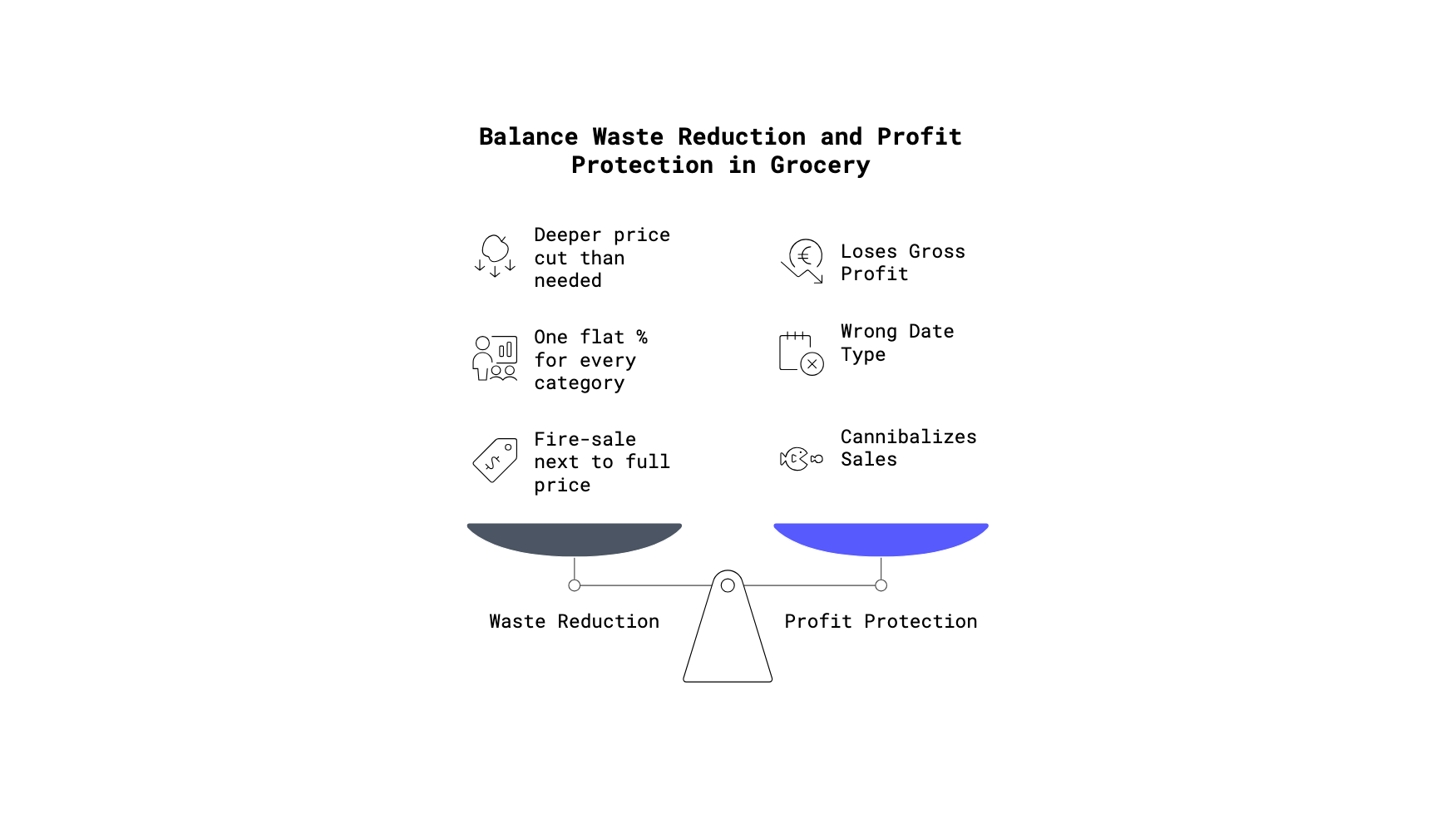
TL;DR: Waste % and gross profit are different numbers. A deeper sticker can clear the shelf and still lose euros versus a smaller cut, a later hold, or a remove. Three patterns show up often in mid-size grocery fresh: cuts deeper than the shelf needed, one flat sticker for every category, and chasing zero expired when a fresh batch sits next to it. All figures below are illustrative examples, not customer results.
Does less waste always mean more profit?
No. Waste % can improve while absolute gross profit falls — because the two metrics answer different questions.
Most fresh teams track waste %. It’s visible, easy to report, and it usually moves in the right direction when you discount more. The catch: a markdown can improve the waste column while quietly hurting the P&L.
Across mid-size grocery fresh, three markdown patterns show up again and again. How common each one is will vary by banner and store — the point is that each one can look “good” on the waste report and still cost euros on the P&L.
Use-By vs Best-Before (EU)
Use-By is a safety date: after it, the food is deemed unsafe and must not be sold (EU Food Information to Consumers Regulation 1169/2011). Typical for highly perishable items such as minced meat.
Best-before is a quality date: the product may still be sold or used after that date under store policy, if it remains acceptable. Typical for many packaged dairy, hard cheese, and pre-packed sliced bread — not for every loaf or soft cheese.
Why can a deeper markdown lose gross profit?
Because clearing every unit below cost can beat zero waste on the report and still leave less absolute € than a shallower cut or a hold.
Take a chilled yoghurt 4-pack: shelf price €2.49, cost €1.70, roughly 32% gross margin. Twelve units hit best-before tomorrow. The store rule says −50% the day before.
- At −50% (€1.25): all 12 sell. Waste: 0. Gross profit: 12 × (€1.25 − €1.70) = −€5.40.
- At −20% (€1.99) from noon: say 10 sell, 2 are written off. Gross profit: 10 × €0.29 − 2 × €1.70 = −€0.50.
The second option has more waste and better gross profit, by almost €5 on one SKU on one day. A −20% cut, or simply holding until the afternoon, would likely have cleared it too — the extra 30 points were profit handed over for nothing. And if this yoghurt usually sells through by evening at full price, the right call was to hold.
The waste report rewards the deep cut. The P&L doesn’t.
Do flat one-sticker markdowns always hurt?
No — but they assume every category behaves the same, and that cost shows up when nobody revisits the rule.
A flat −30% at 18:00 is simple to train and easy to audit. Ops teams defend it for a reason, especially in franchise or high-turnover stores. It is a constraint, not stupidity. The leak appears when the same sticker time and depth are never checked against date type and sell-through by hour.
- Minced meat with Use-By today: it can’t be sold tomorrow. At 18:00 there’s little footfall left, so −30% might move 4 of 10 packs. A smaller cut at 14:00 might have moved 8.
- Hard cheese or packaged bread with best-before today: Best-Before isn’t a hard stop. Depending on your policy, these can often stay on shelf with a smaller reduction, or sell at full price earlier in the day.
- Fast movers on a busy evening: some would have sold at full price anyway. The 18:00 sticker just gives away gross profit.
The leak runs both ways: too late and too shallow on items that won’t sell, too deep on items that would. Timing by date type and sell-through by hour is where the euros are, not the sticker percentage itself. Dynamic pricing can beat flat rules on paper — it also needs labour, data, and often ESL. Flat remains workable when those aren’t in place; the risk is treating it as settled forever.
When does chasing zero expired cost more than the write-off?
When a deep sticker pulls shoppers off the full-price batch next to it — cannibalisation can outweigh the revenue from clearing the old units.
Bagged salad, best-before today, 15 units left at 19:00. A fresh batch sits on the same shelf at €1.99. A −70% sticker (€0.60) clears all 15.
But suppose 8 of those 15 shoppers would have bought the fresh batch at full price. The cost of the old units is spent either way, so compare what changes today:
- Sticker: +€9.00 revenue from the old units, −€15.92 full-price revenue moved off the fresh batch (which now rolls a day closer to its own date). Net: about −€6.90 vs removing. Plus the labour to sticker.
- Remove (or donate): the write-off shows up in waste %, and gross profit is better.
Donation and last-day markdown programmes exist for good reasons — freshness image, landfill avoidance, surplus to charity. The exact cannibalisation rate is still the thing to measure, not assume. When a deep sticker pulls people off the full-price batch next to it, zero waste can cost more than the write-off — when that happens is worth measuring.
What should ops check before the sticker goes on?
Five questions that put absolute gross profit next to waste %, not instead of it.
- Gross margin — what’s the smallest cut that has cleared this item before?
- Date type — Use-By (hard stop) or Best-Before (policy decision)?
- Sell-through — at this hour, is it on track to clear at full price?
- Cannibalisation — is there a fresh batch on the same shelf?
- Scorecard — are waste % and gross profit reported side by side, per category, every week?
Mini scorecard (example-only numbers)
| Fresh dairy, one store | Waste % | Gross profit / week |
|---|---|---|
| Flat −50% day-before best-before rule | 1.8% | €1,120 |
| Smaller cuts timed by sell-through | 2.4% | €1,260 |
If your report only shows the first column, the first row looks like the winner.
FAQ
Does reducing food waste always increase profit?
No. Cutting waste % with a deep markdown can reduce absolute gross profit when the cut is deeper than demand needed, or when it cannibalises full-price sales. Waste and profit must be scored together.
What is the difference between Use-By and best-before?
Use-By is a safety date: after it, the food must not be sold. Best-before is a quality date: under store policy, the product may still be acceptable after that date. EU rules are set out in Regulation (EU) No 1169/2011.
Why do grocery stores use flat markdown percentages?
Flat rules (for example −30% at 18:00) are easy to train and audit. They work as an operating constraint. The cost appears when the same depth and timing are applied to every category without checking sell-through and date type.
When should a store remove stock instead of marking it down?
When a fire-sale would pull shoppers off a fresher full-price batch, or when the discounted price falls below a sensible gross-profit floor relative to expected clear rate. Measure cannibalisation; don’t assume zero expired is always cheaper.
How should markdown performance be reported?
Side by side: waste % and absolute gross profit, per category, every week. A scorecard that only shows waste % will favour the deepest cuts.
Closing
Nobody has “solved food waste.” The narrower question is operational: for each item, each day, there is a choice between hold, markdown and remove. Each one has an absolute gross profit. Less waste ≠ more profit.
That daily choice is what StoreAgent is built around: protect gross profit euros, not just the waste % line.
References
- European Union. Regulation (EU) No 1169/2011 on the provision of food information to consumers — date of minimum durability and ‘use by’ date (Article 24; Annex X). EUR-Lex (2011).
- Wynne-Jones, S. / ESM Magazine. “To Mark Down, Or Not To Mark Down? ECR’s Shrinkage & OSA Group Investigates.” ESM Magazine (2018).
- Sanders, R. E. “Dynamic Pricing and Organic Waste Bans: A Study of Grocery Retailers’ Incentives to Reduce Food Waste.” Marketing Science 43(2): 289–316. INFORMS (2024).