
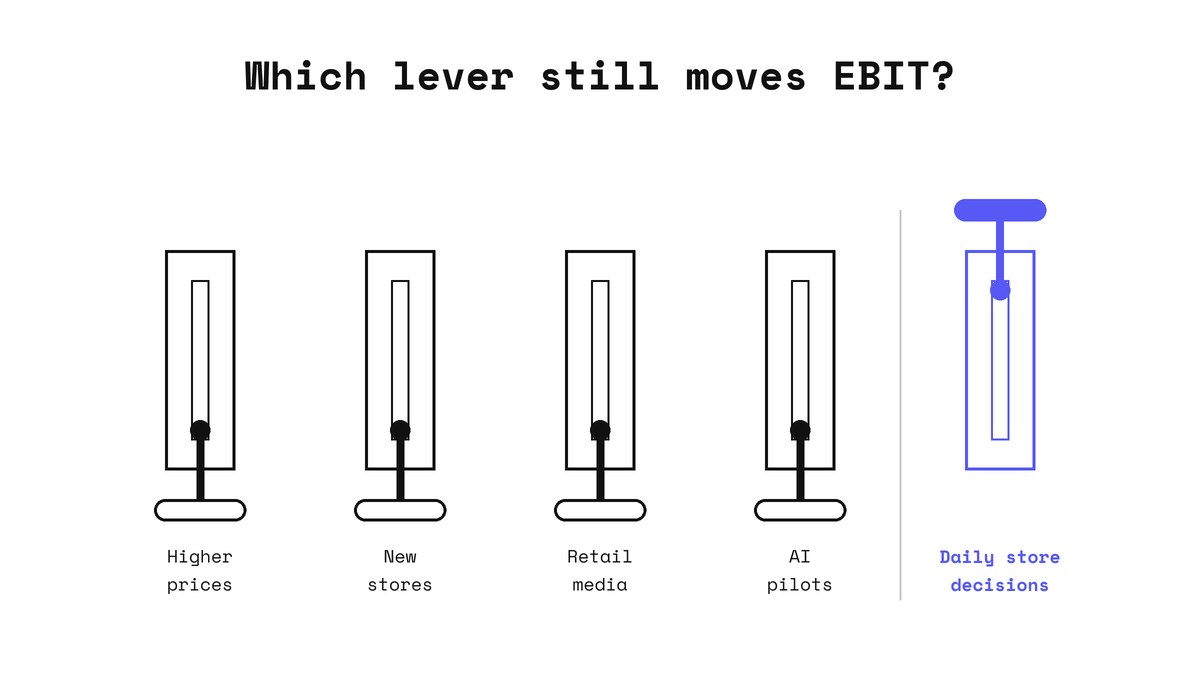
TL;DR: Europe’s grocery EBIT margin sat at 2.8% in 2024 and again in 2025. For the fifth year running, cost and margin pressure is the top concern for grocery CEOs — 77% name it as a top-of-mind focus area. It is not for lack of trying. Labour costs are rising faster than food prices, shoppers resist higher prices, volume is barely growing, and new stores no longer pay their way. Retail media looks rich on paper. Most AI programmes have yet to show a measurable EBIT effect. In our view, the lever that is still open is more EBIT from better daily data-driven execution in the stores grocers already have.
For five years, Europe’s grocery chiefs have named the same worry first: margin. The grocery EBIT margin has given them little back. It was 2.8% in 2024. In 2025 it was 2.8% again.
Why is the grocery EBIT margin still 2.8%?
Because costs have stepped up, the market is barely growing, and shoppers resist higher prices.
McKinsey’s State of Grocery Retail Europe 2026 finds that cost and margin pressure remained the number-one concern for grocery CEOs for the fifth consecutive year. Seventy-seven percent of those surveyed name it as a top-of-mind focus area.
Selling, general and administrative costs tell part of the story. Across nine major European grocers, SG&A reached 19.7% of revenue in 2024 and stayed there in 2025, up from 18.1% in 2015. The ratio has begun to stabilise, McKinsey notes, but at a higher plateau than a decade ago.
Labour is a large reason. In Germany, wages rose 4.0% while food inflation sat at 2.2%. The statutory minimum wage went from €12.82 to €13.90 in January 2026 and is set to reach €14.60 in January 2027. On top of that, the new retail wage deal struck first in North Rhine-Westphalia — and expected to set the pattern elsewhere — raises pay by 3%, then by another 2%. Steven Haarke, the HDE’s tariff lead, said the settlement takes many companies in retail to “the absolute limit of what is still economically bearable” (“die absolute Grenze des wirtschaftlich noch Verkraftbaren”).
About 108,000 retail jobs in Germany are unfilled anyway.
Shoppers have pushed back too. Food in Germany costs about 40% more than at the end of 2019. In McKinsey’s German findings, 49% of consumers plan to save more when they shop this year, and 62% have already switched from brands to private label. Discounters hold 46.1% of the German grocery market. Edeka, Rewe, the Schwarz Group and Aldi together account for just under 85% of it, and the Bundeskartellamt watches this concentrated market closely.
Growth will not wash the problem away. Grocery volume in Europe is forecast to rise by only about 0.2% a year through 2030.
Why did new stores stop paying?
Because selling space in Europe has grown faster than the volume it can sell — and in Germany, chains are already shrinking space rather than adding it.
Since 2019, grocery selling space in McKinsey’s EU-11 markets expanded by about 4.6%, while volume, including online, grew by only about 1.7%. Every square metre sells less.
Germany is further along that curve. It already has 2.4% less selling space than in 2019. Across German retail as a whole, investment in store expansions and refurbishments fell 23% between 2023 and 2025, to €7.02 billion. EHI notes that new openings have not generally translated into market-share gains, in part because many new stores are relocations.
Does retail media change the grocery EBIT margin?
On paper it looks like one of the richest profit pools in grocery. How much of that is new EBIT is a different question.
McKinsey puts retail media among the fastest-growing profit pools in the sector, with EBIT margins of about 70% and projected growth of around 20% a year from 2025 to 2028. That is a real adjacency. For grocers who can sell genuinely incremental advertising — new brand spend, measured against real shopper data — it can add EBIT.
In our view, much of what is booked as retail media today is money brands already pay through the purchase price. It moves from a lower cost of goods onto a media line. The accounting looks better. The grocery EBIT margin does not change. The part that is genuinely new needs scale and data: a large customer base, enough media inventory, and the technology to measure it. Strategy& warned in 2026 that retailers without sufficient scale or data maturity will destroy value by trying to build a fully proprietary retail media stack. That work goes mostly to the biggest players.
Why hasn’t AI moved EBIT yet?
Because most programmes are not pointed at a bottleneck, and few have been measured against EBIT at all.
In McKinsey’s 2026 grocery CEO survey, 47% named adopting AI and automation as one of their top three priorities — second only to cost and margin pressure. Seventy percent report no measurable EBIT impact from AI so far, or say it is too early to tell. Only 3% report an EBIT gain of more than 5%. About 30% report some initial P&L impact, below 5%. Only 8% have established agentic AI use cases, and no organisation in the survey has scaled agent deployment across functions.
In our view, AI pays off at a bottleneck. Applied anywhere else, it adds complexity, not EBIT. Grocery has several bottlenecks. One of the biggest is the store: the decisions teams make every day about which item, how much, and when.
Those decisions show up in familiar places. A flat markdown on every item that has to go, or the same sticker on a Use-By pack and a Best-Before pack, are daily calls. Each one moves only a little gross profit. Together, they add up.
Where does the next point of EBIT come from?
From better daily data-driven execution in the stores grocers already have.
Prices are hard to lift when shoppers are trading down. New space is not paying for itself. Retail media, in our view, is only partly new money, and the new part favours the largest groups. AI, pointed at the wrong problem, has not moved the grocery EBIT margin.
The lever that is still open is more EBIT from the stores that are already open: better daily decisions, made with data, on the shop floor.
That’s what StoreAgent is built for: data-driven daily tasks for store teams, with each task’s effect on margin measured.
FAQ
What is the grocery EBIT margin in Europe?
McKinsey’s State of Grocery Retail Europe 2026 puts the grocery EBIT margin at 2.8% in both 2024 and 2025.
Why do grocery CEOs still put margin first?
Cost and margin pressure has been their number-one concern for five consecutive years. Seventy-seven percent of CEOs in the 2026 survey name it as a top-of-mind focus area. SG&A sits at 19.7% of revenue, labour is rising faster than food prices, and volume is forecast to grow by only about 0.2% a year through 2030.
Does retail media improve the grocery EBIT margin?
Retail media can show EBIT margins of about 70%. In our view, much of that is trade spend that was already in the supplier contract, moved from the cost of goods to a media line, so group EBIT does not change. The genuinely new part needs scale and data, so it accrues mostly to the biggest players.
Where should grocers look for the next point of EBIT?
In our view, in better daily data-driven execution in the stores they already have — the decisions store teams make each day about which item, how much, and when.
Sources
- McKinsey & Company / EuroCommerce / Europanel, The State of Grocery Retail Europe 2026, April 2026. Report page · PDF
- McKinsey Germany, press release on the State of Grocery 2026, 22 April 2026. PDF
- Bundesministerium für Arbeit und Soziales, statutory minimum wage (overview). bmas.de. The €12.82 rate that applied from 1 January 2025 is listed in the BMAS minimum-wage table.
- Handelsverband Deutschland (HDE), “Durchbruch bei Tarifverhandlungen im Einzelhandel – Tarifabschluss in NRW”, 26 August 2026. einzelhandel.de
- Handelsverband Deutschland (HDE), “Erfolgsmodell Westbalkanregelung: HDE warnt vor Halbierung des Kontingents”, 28 October 2026. einzelhandel.de
- rundschau.de, reporting EHI figures, “Supermärkte gewinnen Marktanteile zurück”, 3 September 2026. rundschau.de
- Andreas Mundt, “Intensiv durchleuchtet: Die Lebensmittelbranche im Fokus des Bundeskartellamtes”, Die Politische Meinung 26/I, no. 594. PDF
- ESM Magazine, reporting EHI, “German Retailers Invest More In Store Optimisation Than New Openings, EHI Says”, 26 February 2026. esmmagazine.com
- Strategy&, Grocery Retail Outlook 2026, 6 February 2026. strategyand.pwc.com