
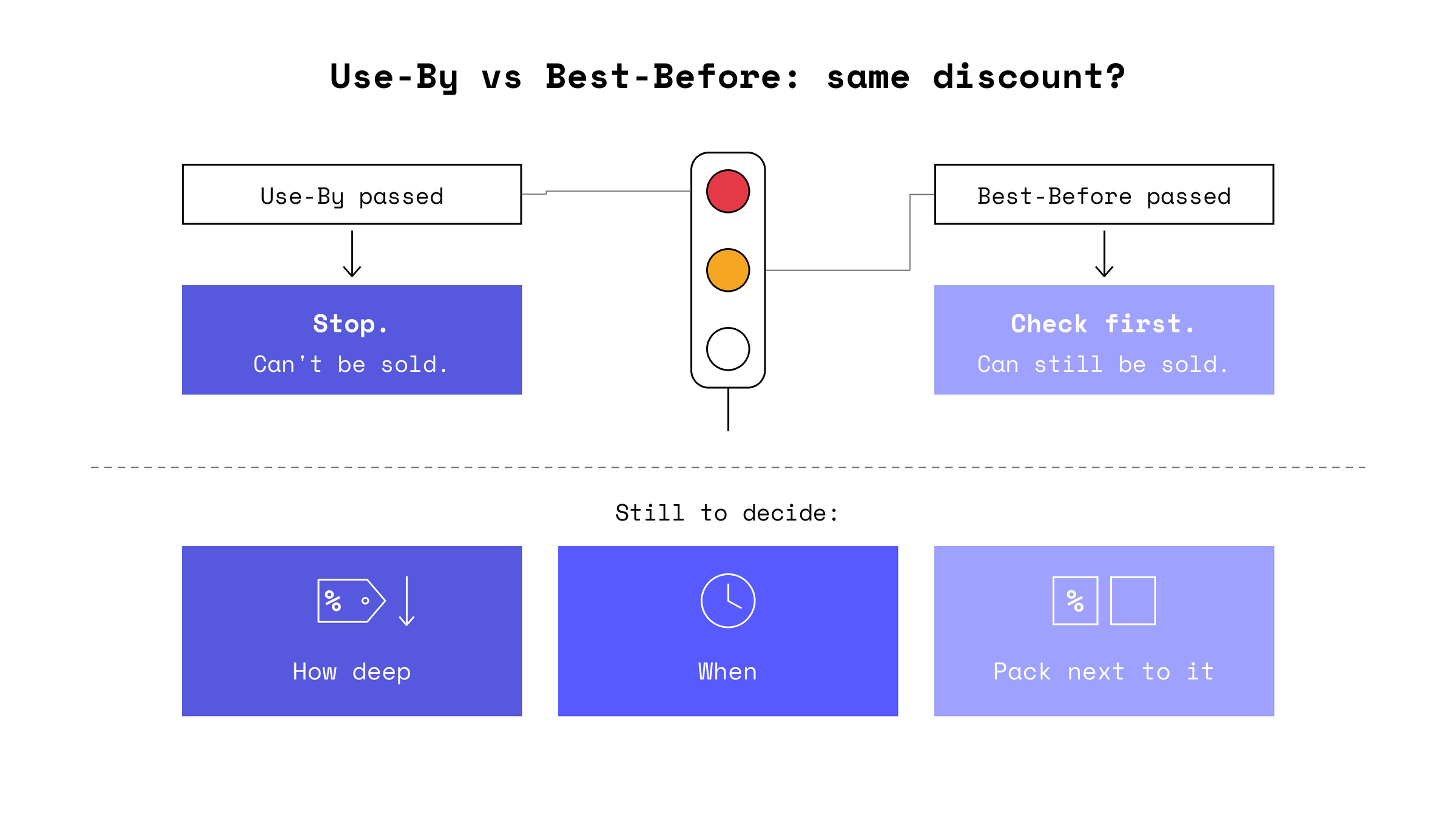
TL;DR: Use by vs best before is not only a shopper question. For a store, a passed Use-By date is a red light: the pack can’t be sold. A passed Best-Before date is a yellow light: check first. If the product is still fine and the passed date is clearly pointed out, it can be sold, and the store is now responsible for it, not the maker. Yet the discount sticker often looks the same on both. Knowing which date is on the pack is having the data. Acting on it takes three decisions: how deep, when, and what the cheaper pack does to the full-price pack next to it. That’s what StoreAgent is built for.
Would you treat a red light and a yellow light the same way? In a supermarket chiller, both sit side by side. Minced meat and poultry carry a Use-By date. Yoghurt and most cheese carry a Best-Before date. The discount sticker on them often looks the same.
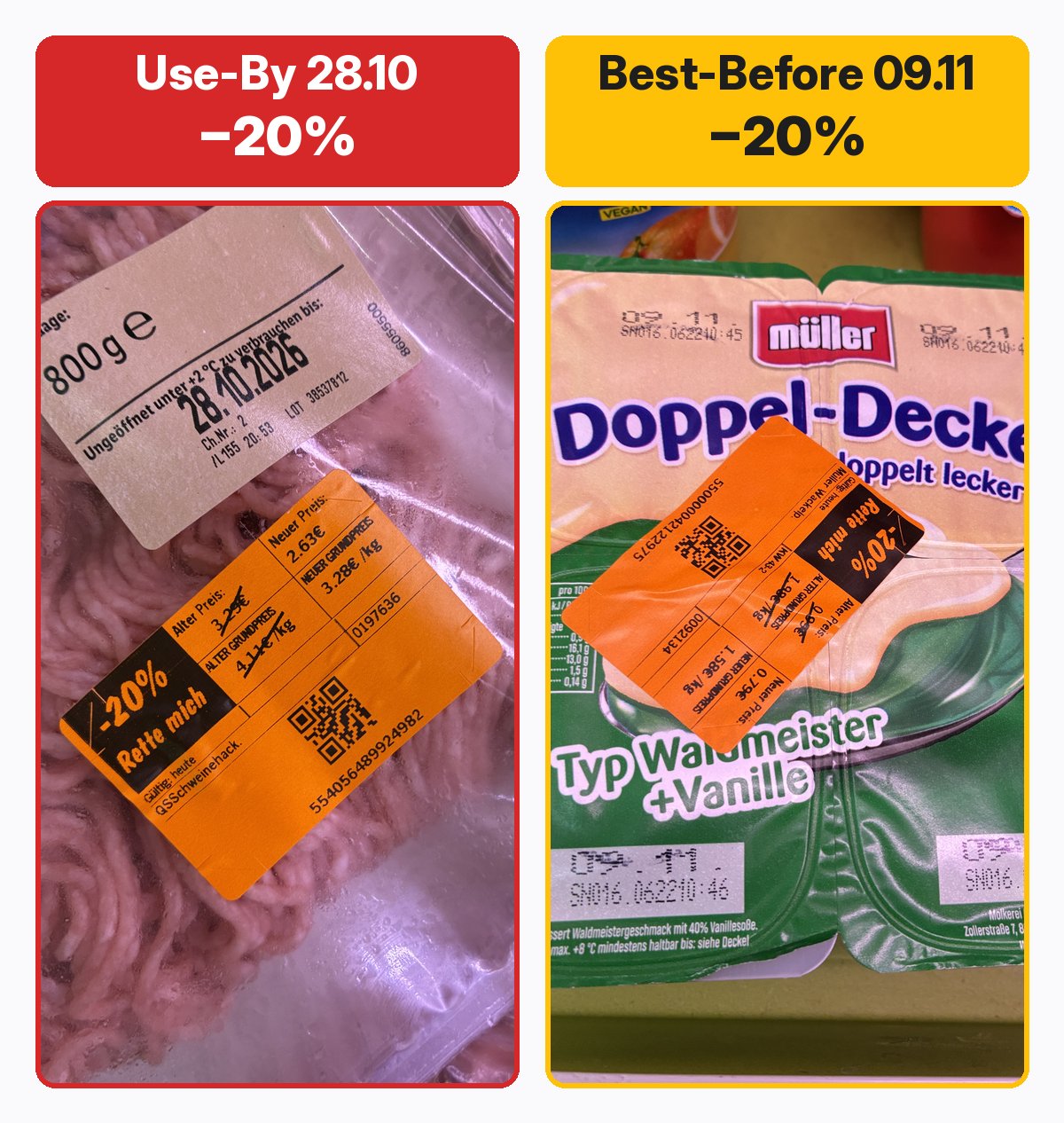
Use by vs best before: what can a store do with each?
Use-By is a safety date. Best-Before is a quality date. After each date passes, the store is allowed to do different things.
| Use-By (“zu verbrauchen bis”) | Best-Before (“mindestens haltbar bis”) | |
|---|---|---|
| What it is | Safety date for food that spoils fast | Quality date: the maker’s promise on taste, smell and texture |
| Typical chiller products | Minced meat, poultry, smoked fish | Yoghurt, most cheese |
| After the date passes | Red. Can’t be sold or donated. Can’t be repacked or relabelled. | Yellow. Check first. If still fine and the passed date is clearly pointed out, it can be sold. The store, not the maker, is now responsible. |
A chain’s own policy can be stricter than the law. Some chains don’t sell Best-Before items past the date at all. The point here is not to sell more past the date. It’s to price each pack well before it gets there.
Why does one sticker for both dates cost gross profit?
Because a red-light pack on its last day and a yellow-light pack with days left face different deadlines. The same discount, at the same hour, can’t be right for both.
A flat sticker has real advantages. Staff can apply it in seconds, the same way in every store, and shoppers learn to trust it. The cost shows up in gross profit. Two illustrative estimates (not customer data; assumptions listed):
Estimate A: Use-By mince, last day. 10 packs in the morning. Shelf price €4.99, cost €3.40, −20% price €3.99. Unsold packs are written off at cost.
- Sticker in the evening (assumed): 3 sell at full price during the day (+€4.77), 2 sell after the sticker (+€1.18), 5 are written off (−€17.00). Gross profit: −€11.05.
- Sticker in the morning (assumed): 8 sell at €3.99 (+€4.72), 2 are written off (−€6.80). Gross profit: −€2.08.
Same −20%, different hour: about €9 of gross profit difference on one product in one store.
Estimate B: Best-Before yoghurt, 12 days left. 12 pots. Shelf price €2.49, cost €1.70, −20% price €1.99. Assumed: normal sales would clear them at full price before the date.
- No sticker yet: 12 × €0.79 = €9.48 gross profit.
- −20% now: 12 × €0.29 = €3.48 gross profit.
That’s €6.00 given away with no waste saved. If sales are slow, an early cut can still be right. The answer depends on the date type, the days left and how that product is selling in that store that day.
Which three decisions does the date type change?
How deep, when, and what happens to the full-price pack next to it.
- How deep. A red-light pack on its last day and a yellow-light pack with days left may need very different cuts.
- When. A pack cut in the morning has the whole day to sell. Cut in the evening, it has a few hours.
- The pack next to it. Reduced packs often sit right next to full-price ones. A cheap pack can take the sale from the full-price one beside it, and that one can become tomorrow’s markdown.
Research from 2026 points the same way. In a simulation by Riesenegger and Hübner (Technical University of Munich), small discounts cut food waste by up to 80%. But whether a discount paid off depended mostly on how shoppers pick packs: it worked best where many reach for the freshest pack, and where few do, discounting wasn’t profitable in their model.
Is knowing the date type enough?
No. Knowing which date is on the pack means having the data. Acting on it is the hard part.
Someone still has to make these calls for every dated pack, every day. A smart decision doesn’t have to mean a complicated job for staff: the instruction can stay simple (this sticker, on this pack, at this time) while the decision behind it weighs the date type, the days left, the time of day, how the product is selling and the full-price stock next to it. Those factors change for every pack, in every store, every day.
That’s what StoreAgent is built for: reading the date type, then picking the discount, the time and the effect on the full-price pack next to it, to protect gross profit.
FAQ
What is the difference between Use-By and Best-Before for a store?
Use-By is a safety date: once it passes, the food can’t be sold. Best-Before is a quality date: after it passes, the food can still be sold if it is still fine and the passed date is clearly pointed out. The store is then responsible for it, not the maker.
Can a supermarket sell food after the Best-Before date?
Yes, in Germany, if the food is still fine and the passed date is clearly pointed out. There is no fixed deadline. Some chains choose not to sell it and donate it instead.
Can food past its Use-By date be sold or donated?
No. Once the Use-By date has passed, the food can’t be sold or donated, and it can’t be repacked or relabelled.
Why do stores often use the same sticker for both dates?
A flat sticker is fast to apply, easy to train and easy to check across many stores. The cost is that it ignores the date type, the days left, the time of day and the full-price pack next to it.
Does a discount always pay off?
No. A 2026 simulation from the Technical University of Munich found that small discounts can cut waste by up to 80%, but whether they pay off depends mostly on how shoppers pick packs.
Sources
- DerWesten, “Was passiert eigentlich mit abgelaufener Ware bei Rewe?”, 16 Jul 2026. derwesten.de
- DerWesten, “Rabatt-Sticker bei Edeka: So kannst du wirklich dabei sparen”, 27 Aug 2026. derwesten.de
- Riesenegger, L. & Hübner, A., “Balancing profitability and waste reduction: optimizing markdown policies for retail inventory”, International Journal of Production Research, published online 13 Jan 2026. doi.org
Grocery teams: in your stores, does the discount change with the date type, or does every pack get the same sticker?