
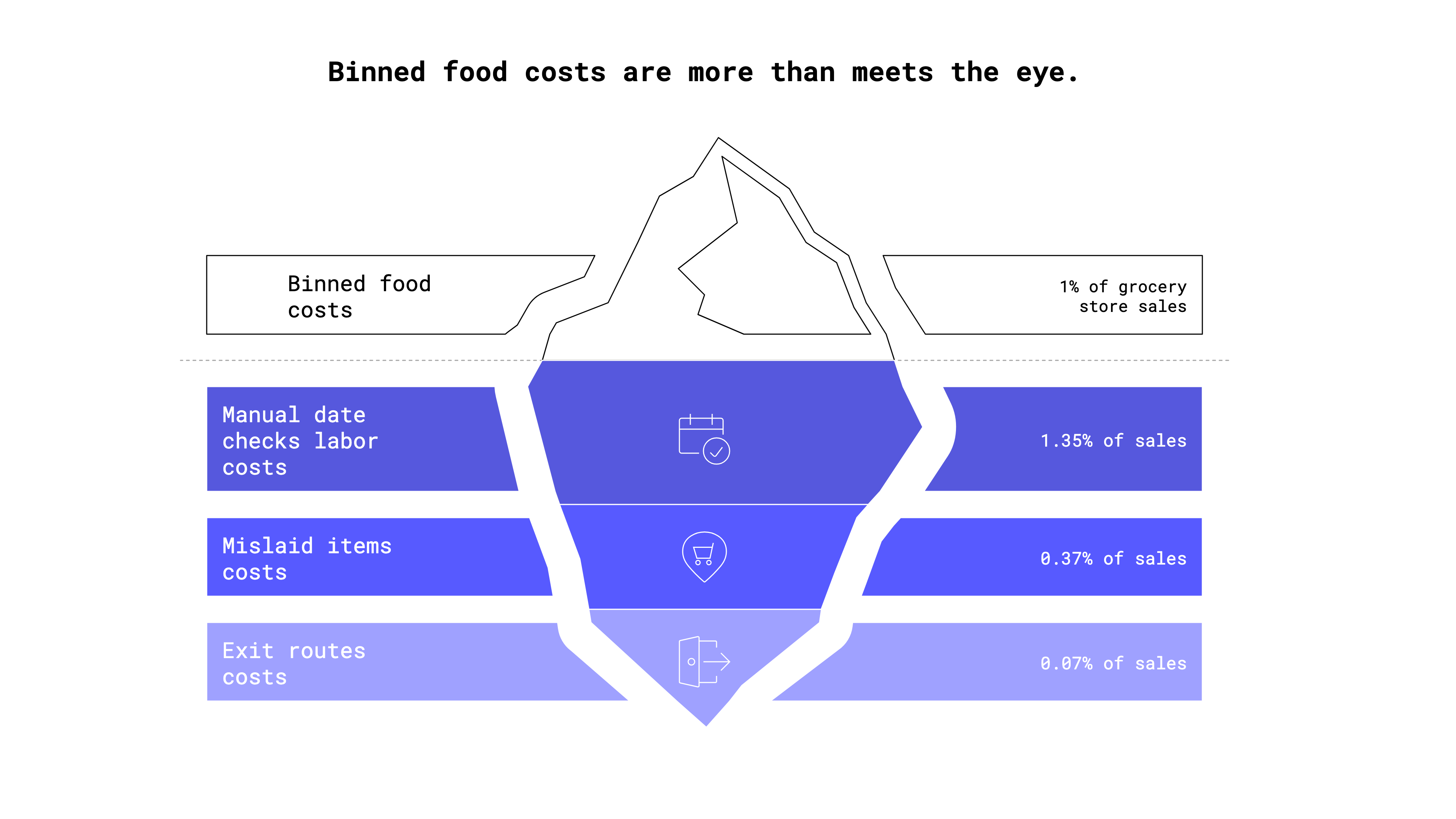
The food waste cost a supermarket carries is about 2.8% of sales. About 1% is the purchase cost of food that gets binned or donated. About 1.8% goes on handling all the food that doesn’t sell at full price. That’s mostly manual date checks and markdowns. Source: ECR Retail Loss, 2025.
The figures come from Exploring the True Cost of Unsold Food in Retail (ECR Retail Loss, 2025), by Prof. Lisa Jack, Prof. Chris Simms and Prof. PK Senyo at the University of Portsmouth. They studied four retailers in the UK and Europe.
What is the true cost of food waste?
It has two parts.
- About 1% of sales: the purchase cost of food thrown away, donated or redistributed. This is the number most P&Ls show as waste.
- About another 1.8% of sales: the cost of handling all food not sold at full price. That includes markdowns, surplus, waste and unexplained loss.
Head office tracks the 1% that gets binned. The 1.8% spent handling it never shows up in the waste report.
Why doesn’t the 1.8% show up?
It’s booked somewhere else.
- Waste is booked at purchase cost. A pack sold below cost loses gross profit, but that loss isn’t in the waste line.
- Time spent checking dates and re-pricing is booked as wages.
- Unexplained loss is usually written off as a general expense.
None of the four retailers could give the researchers all the data in one place. It sat in separate systems.
Food waste cost in a supermarket: where does the 1.8% go?
| Cost | Share of sales |
|---|---|
| Manual date checks and markdowns | 1.35% |
| Mislaid and stolen items | 0.37% |
| Exit routes (donation, anaerobic digestion etc.) | 0.06% |
| Management | 0.01% |
Source: ECR Retail Loss (2025), Figure 5.
Every retailer interviewed said staff time was the biggest cost: checking items on shelf, marking them down, taking them off.
One retailer timed it. Checking one block of items on a shelf or in a cabinet took 1.9 minutes on average. ECR costs staff time at €0.25 a minute.
Records suffer too. When time is short, staff skip the harder entries. ECR saw between 1 unrecorded item for every 3 recorded, and 2 unrecorded for every 1 recorded.
What does that look like for one store?
Illustrative example, not customer data.
A store with €10 million in yearly sales:
- Binned food (~1%): €100,000
- Handling (~1.8%): €180,000, of which checks and markdowns (1.35%): €135,000
If staff check 300 fresh shelf blocks twice a day, that’s 1,140 minutes, or 19 staff hours a day. At €0.25 a minute, that’s about €104,000 a year.
How does a 35% product end up at −4%?
ECR follows one chilled product: 1,000 units bought at €3.25, priced at €5.00.
- 35% gross margin if every unit sells at full price.
- 34% once each item is checked twice. That adds €51.
- 29% when 1 in 5 packs is marked down to cost price.
- 27% when a few packs are also lost without a record (20 units), and 10 go to donation or incineration.
- −4% when you use the full cost to serve (about 95% of the price, covering staff, energy and logistics) instead of purchase cost.
ECR’s bottom line: unsold food costs about €0.018 per €1 of sales, or €0.027 per €1 purchased. On a product with a net margin under 1.8%, that can wipe out the profit.
For how this links to profit more broadly, see Does reducing food waste increase profit?
Won’t 2D barcodes or expiry alerts fix this?
They help. They tell staff which pack is near its date.
They don’t say what to do with it: keep it, mark it down or take it off. They don’t set the discount either. That decision is where gross profit € is lost. In ECR’s numbers, the drop from 34% to 29% comes from markdowns, not from missing dates.
ECR also says cutting the number of checks per product would make a big difference. An alert that still sends staff to every shelf doesn’t do that.
How can a supermarket cut it?
- Only check packs that need a decision. Not every shelf, twice a day.
- Check the date type first. A Use-By pack past its date comes off. A best-before pack can stay or be marked down.
- Set the discount per pack. A flat sticker on everything gives away gross profit € on packs that would have sold anyway.
- Rotate with FEFO (first-expired, first-out). Fewer packs then need a markdown.
One-week check for your store
- Binned and donated food at purchase cost (€)
- Markdown value given away (€)
- Checks per day × blocks × 1.9 min × €0.25 × 7 (€)
- Unexplained loss in fresh (€)
Compare line 1 with lines 2–4 added up. Show both to finance and the fresh manager in the same meeting.
Where StoreAgent fits
StoreAgent sends alerts that tell staff which pack to mark down, when, and by how much. Use-By rules and FEFO are built in. Staff do fewer manual checks, and gut-feel flat stickers go.
FAQ
How much does food waste cost a supermarket?
About 2.8% of sales, according to ECR Retail Loss (2025): about 1% for binned and donated food at purchase cost, plus about 1.8% for handling unsold food.
What makes up the 1.8%?
Manual checks and markdowns (1.35%), mislaid and stolen items (0.37%), exit routes (0.06%) and management (0.01%).
How long does a shelf date check take?
1.9 minutes on average per block of items, measured by one retailer in the ECR study.
Do expiry alerts solve the problem?
Not on their own. They flag the date. They don’t decide whether to keep, mark down or remove a pack, or by how much.
Where can I read the ECR report?
At ecrloss.com.