
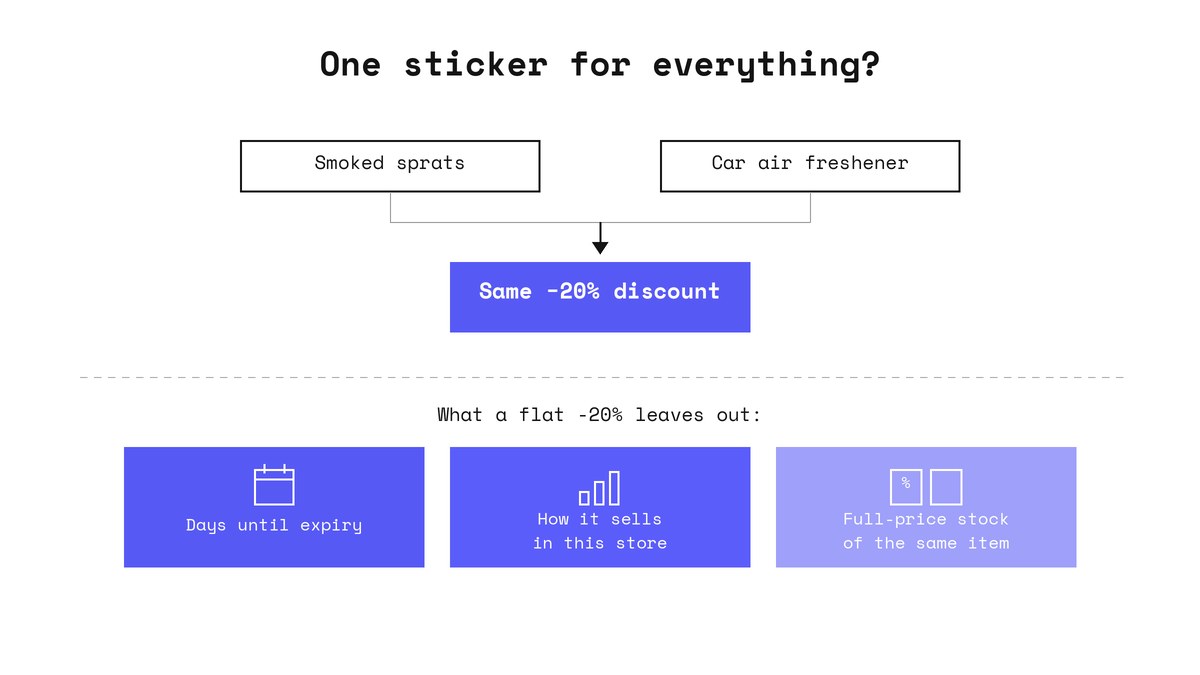
TL;DR: Many grocers run a simple grocery markdown strategy: one discount for everything that has to go. In one Lidl “Rette mich” bin, smoked sprats and a car air freshener carry the same −20% sticker. That flat rule is a smart trade-off: fast, easy to train and the same in every store. What it leaves out is how many days each item has left, how it sells in that store, and how much full-price stock sits nearby. The fix is not a more complicated sticker. It’s a better decision behind a sticker that stays simple.
What do smoked sprats and a car air freshener have in common? In this bin, the same −20% sticker.
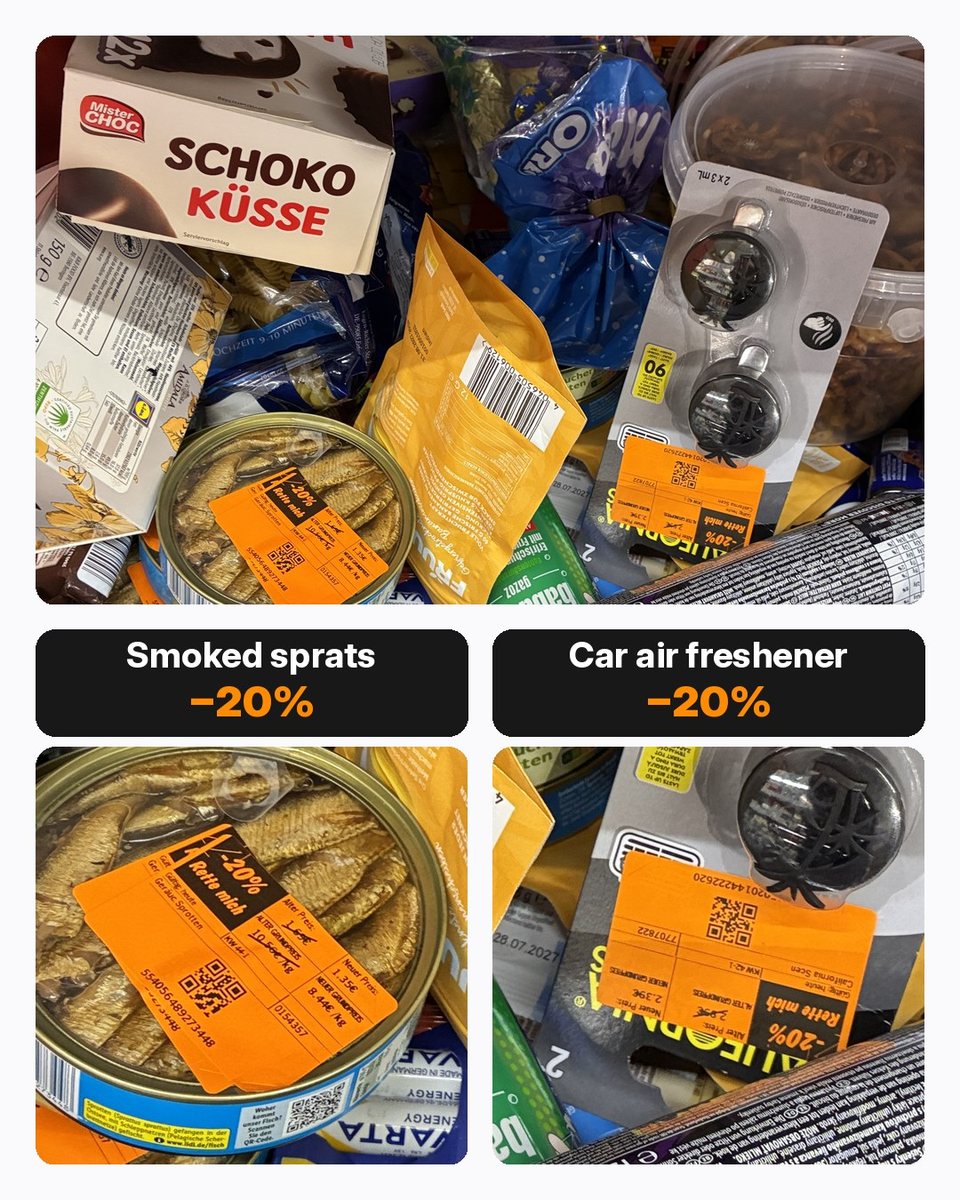
What does the bin actually show?
Very different items, the same −20%.
The bin holds smoked sprats, chocolate marshmallows, Milka Oreo, pasta, batteries and a car air freshener. Take two of them:
- Smoked sprats: −20%, from €1.69 to €1.35.
- Car air freshener: −20%, new price €2.39.
The sprats are food with an expiry date. The air freshener isn’t food at all. So the bin isn’t only about expiry dates. Items end up there for different reasons, and the sticker treats them the same. Lidl does use deeper reductions too: a −40% sign hangs right under this bin. The point here isn’t that Lidl never goes deeper. It’s that two items this different get the same cut.
Why is one flat discount a smart trade-off?
Because it’s fast, consistent and easy to trust, and those things matter in thousands of stores.
Lidl describes its approach in 2026 like this: bakery, dairy and frozen products get a 20% discount a few days before and on their Best-Before day, and go into green “Rette mich” boxes. A Lidl spokesperson told the Berliner Morgenpost that its fixed-price fruit and veg bag runs in all 3,250 stores.
A flat rule fits that scale. Staff learn it once. It takes seconds per item. Shoppers learn what the sticker means. It’s easy to check from head office. Lidl is one of the most efficient retailers in the world, and choosing a simple rule is part of how it stays that way.
There is criticism too. A Berlin newspaper column in 2026 argued that 20% is often too little to make a shopper pick up the item. That’s a view, not a measurement. But it points at the real question: not whether 20% is right, but whether any one number can be right for every item at once.
What does a flat grocery markdown strategy leave out?
Three things that change for every item, in every store, every day.
- Days left. An item a few days from its expiry date and one on its last day get the same cut. The first may still sell at full price. The second may need more than −20% to sell in time.
- How it sells in this store. The same product sells fast in one store and slowly in another. A fixed cut gives away gross profit where the item would have sold anyway, and isn’t enough where it wouldn’t.
- Full-price stock nearby. A discounted item can take the sale from a full-price one of the same product on the shelf. That one may then end up in the bin later.
Take the sprats. The sticker takes €0.34 off each tin. If that tin would have sold at full price anyway, that’s €0.34 of gross profit given away. If it would have sat until its expiry date, −20% may still not be enough, and the tin ends up donated or thrown away. The sticker is the same either way. The right answer isn’t.
Does a smarter markdown mean more work for store staff?
No. The instruction can stay as simple as it is today.
Keeping the sticker simple is right. Keeping the decision behind it simple is where gross profit leaks. A store team doesn’t need a longer rulebook. They need one clear instruction (this sticker, on this item, now), with the decision behind it weighing the days left, how the item sells in that store, the full-price stock nearby and the time of day.
That’s what StoreAgent is built for: staff still apply one simple sticker, but the discount on it is set for that item in that store, deep enough to sell in time and no deeper, so gross profit stays protected.
FAQ
What is a flat markdown?
A flat markdown is one fixed discount, such as −20%, applied to every item that needs to sell before its expiry date, regardless of the product, the days left or how it sells.
Why do grocers use the same discount for everything?
It’s fast to apply, easy to train, easy to check across many stores and easy for shoppers to understand. That’s a real advantage at scale.
Is a 20% discount enough?
Sometimes it’s more than needed and sometimes it isn’t enough. It depends on the item, the days left, how it sells in that store and the full-price stock nearby.
Does a smarter grocery markdown strategy mean more work for staff?
It doesn’t have to. Staff can still apply one simple sticker. What changes is the decision behind which sticker goes on which item, and when.
Sources
- FF Future Foods / fleischnet.de, interview with Miriam Schroer (Lidl Germany), “Bezahlbare Normalität für alle als Ziel”, August 2026. fleischnet.de
- Berliner Morgenpost, on supermarkets fighting food waste, 21 May 2026. morgenpost.de
- B.Z. Berlin, column “Der Schwarze Peter”, 14 Mar 2026 (opinion). bz-berlin.de
Where would you draw the line: one simple sticker for everything, or a different discount for each item?