
AI for Expiry Management in Grocery Stores detects expiry risk earlier
and turns it into daily store actions that reduce waste and protect margin.
Food retail operates on thin margins — typically 1–3%.
At the same time, food waste costs EU retailers around €11 billion every year.
That is not a sustainability issue. That is profit disappearing.
Why Expiry Management in Grocery Stores Fails
Most retailers track inventory quantities, sales velocity, and forecasts.
Expiration dates may even exist in the ERP at batch level.
But in many cases, expiry risk is not surfaced early enough
where daily decisions happen — in the store.
Store teams rely on manual checks.
Products are marked down late.
Write-offs happen when options are already limited.
The issue is not missing data.
It is late detection and delayed action.
What Effective Expiry Management Requires
To reduce waste, expiry risk must be detected days in advance
and translated into clear daily priorities.
- Capture expiry information at SKU and batch level.
- Combine it with stock and sales data.
- Identify products at risk before they expire.
- Recommend specific daily actions.
- Confirm that those actions were completed.
Earlier detection.
Clear action.
Measurable execution.
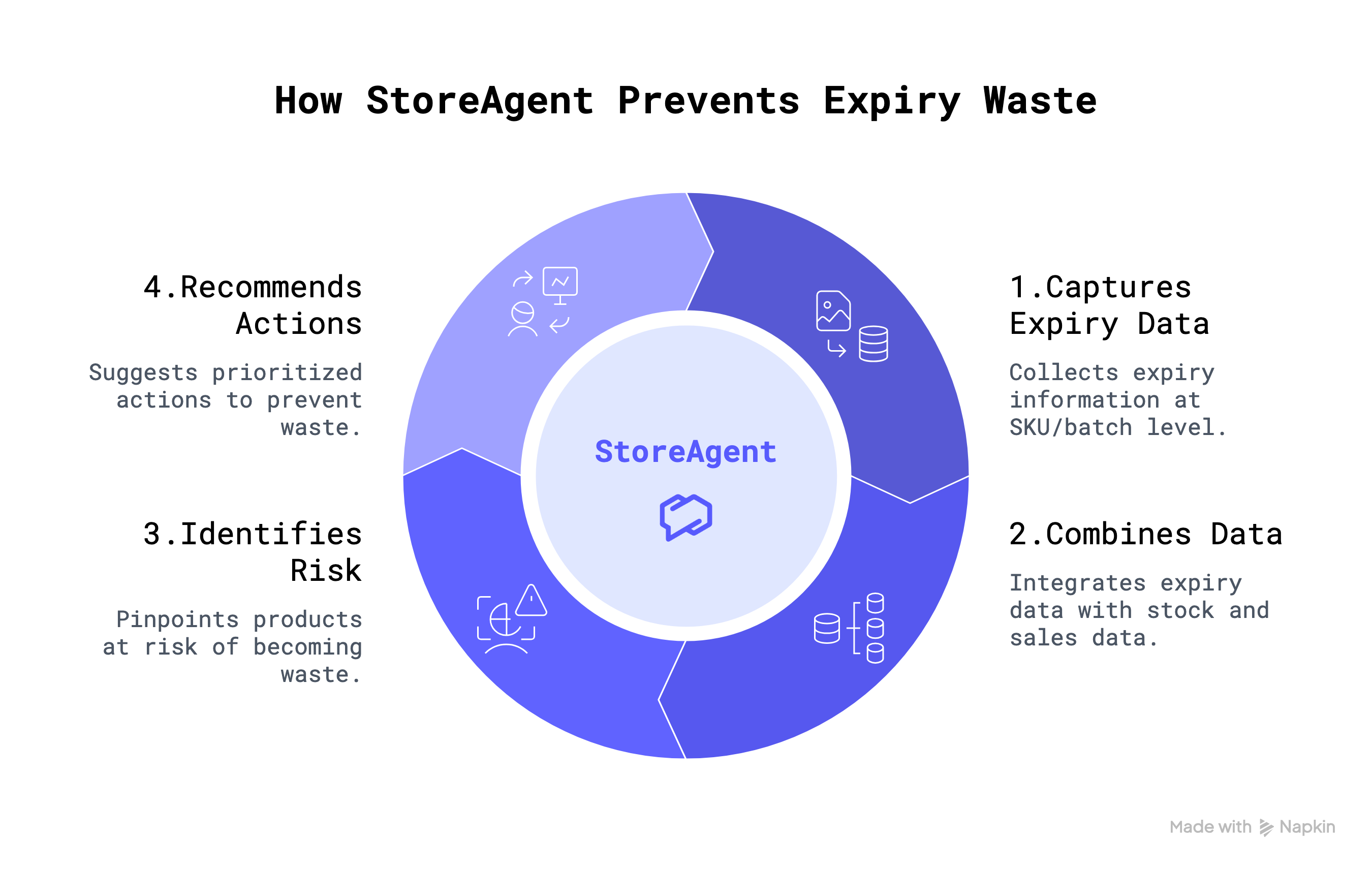
How StoreAgent Prevents Expiry Waste
StoreAgent operates at the execution layer of the store.
It captures expiry data at SKU and batch level,
analyses stock and sales dynamics,
and converts risk into prioritized daily actions for store staff.
The system combines statistical prediction models with LLM-based reasoning
to detect at-risk products early and translate that insight into clear daily priorities.
Store teams receive guidance on what to mark down, move, or prioritize.
The system tracks whether actions were completed.
It runs on devices store staff already use.
No new hardware.
No complex IT integration.
When expiry risk is detected earlier, stores act earlier.
Waste decreases. Margin improves.